
Could Bees Really Be Teaching Each Other Through Dance?
How honeybees perform complex wiggles to share GPS coordinates of flower patches
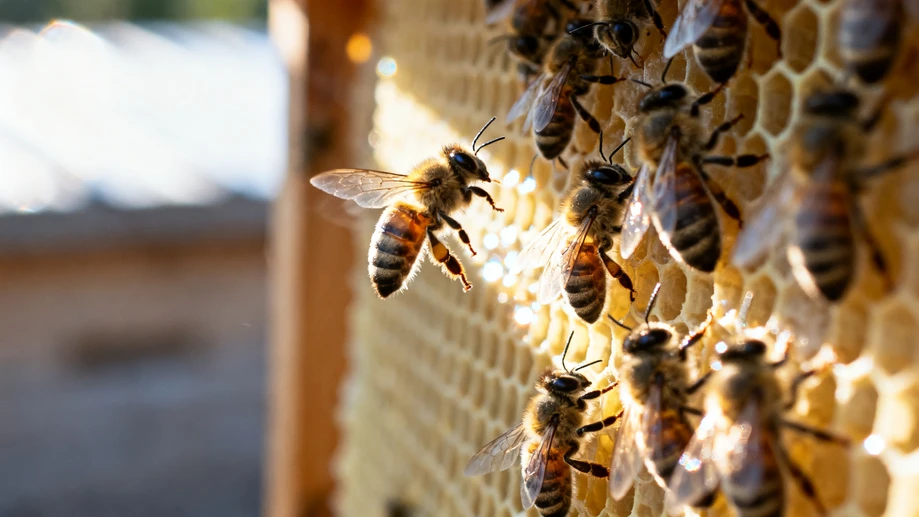
Imagine discovering an entire language based on body movements right in your backyard. Honeybees have perfected this over 20 million years through their legendary "waggle dance." When a forager finds a promising nectar source, she returns to the hive and performs a coded routine on the honeycomb. The direction of her straight-line shuffle indicates the sun's position relative to the flowers, while the duration translates to distance. Faster vibrations mean closer treasures, and enthusiastic dancers recruit more followers by offering floral-scented samples. This insect Morse code allows colonies to deploy workers with GPS-like precision.
Scientists using thermal cameras discovered an overlooked layer: bees actually headbutt dancers during performances. This isn't aggression but a "stop signal" – like coworkers tapping a shoulder during a presentation. When multiple scouts advertise competing locations, headbutting helps resolve debates by silencing inferior dancers. Researchers at Rutgers University observed this democratic process optimizes collective decisions; colonies with active signalers chose higher-quality feeding sites 90% of the time. Next time you see bees buzzing, they might be holding a business meeting.
The dance floor geometry reveals further genius. Bees perform on vertical honeycombs in complete darkness, yet accurately transpose horizontal flight paths. How? They sense gravity through leg sensors and convert sunlight angles into gravitational vectors. If a flower lies 30 degrees left of the sun, the dancer angles her waggle run 30 degrees left of upward. Cloudy days pose challenges, but bees compensate using polarized light patterns invisible to humans. Their internal compass even adjusts for the sun's movement mid-dance – a feat that inspired early robot navigation algorithms.
Climate change adds unexpected twists to this ancient communication. Rising temperatures alter flower distributions, forcing bees to travel farther. Longer waggle dances now exhaust dancers physically, like marathon runners giving directions while gasping for breath. Pesticides compound the issue by causing dancers to misreport locations by up to 400 meters. Ecologists warn these disruptions could collapse pollination networks, but urban beekeepers help by planting diverse gardens. Your lavender bush might host dance rehearsals for tomorrow's nectar expedition!
Beyond pollination services, bee dances revolutionize technology. Engineers mimicked the system for warehouse robots that "recruit" helpers via Wi-Fi signals instead of wiggles. Neuroscientists study how bee brains process spatial data without a hippocampus. Most remarkably, this behavior emerges from insects with brains smaller than sesame seeds. As we decode nature's solutions, perhaps we'll discover that the most sophisticated communication systems aren't digital – they're buzzing right outside our windows.