
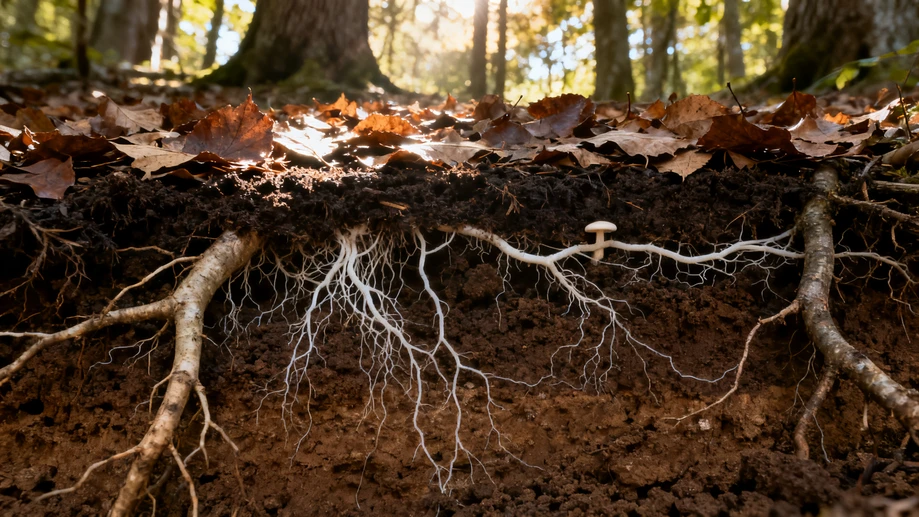
Do You Know Every Tree In A Whole Forest Secretly Chats Underground Through Hidden Fungal Networks
Recent years of continuous field monitoring in the Pacific Northwest temperate forest zones have recorded the long-unobserved underground interactive system that links thousands of trees, overturning people’s long-held assumption that woody plants are completely static and isolated individuals.
Most casual hikers wandering through old growth temperate forests usually only focus on the towering crowns, the rustle of fallen leaves underfoot, or the wild berries peeking out from under shrubs, rarely sparing a thought for the dark, damp world a few centimeters below their boots. For generations, popular science materials have portrayed individual trees as independent, stationary organisms that only compete with nearby neighbors for sunlight, water and limited soil nutrients, with no way to exchange information or resources after their roots are fully anchored in the ground. This common sense assumption stood unchallenged for decades, until continuous tracking of mycorrhizal fungi in forest soils revealed a sprawling, complex web that connects nearly every living tree in a given ecosystem into one large, interconnected community. The tiny white threads of these fungi, called hyphae, are often 10 to 50 times thinner than a single human hair, spreading out through every gap in the soil to weave a network that can stretch dozens of kilometers in the area covered by a single footstep.
The latest set of observational data collected over 18 consecutive months in the Willamette National Forest marked more than 270 Douglas firs of different ages across a 40-acre research plot, using non-invasive isotope tracers to track the movement of chemical signals and carbon molecules between different plant individuals. When researchers manually introduced a small cluster of aphids to the leaves of a 40-year-old fir at the center of the plot, they were surprised to find that the warning signal of pest attack spread through the underground fungal network to all trees within a 30-meter radius in less than 48 hours. Every recipient fir had already secreted bitter terpene compounds into their new leaf tissues to repel aphids before any airborne pest pheromone could reach them, cutting the potential infection rate across the group by more than 70 percent compared to isolated trees growing outside the network’s coverage. Researchers also noted that trees struck by drought will send out special chemical signals through the hyphae, prompting nearby individuals to adjust their root water absorption rate to reserve shared water resources for the driest plants, preventing widespread mortality across the forest in unusually hot summer months.
One of the most fascinating details uncovered by the monitoring work is the core role played by centuries-old “mother trees” that have grown long enough to build far more extensive hyphal connections than younger, smaller individuals. These old giants usually have dozens of times more linked hyphal threads than a 10-year-old sapling, and they actively allocate large portions of their stored sugar produced through photosynthesis to young offspring growing under their own shaded canopy, where sunlight levels are too low for small trees to produce enough energy to survive on their own. Many local wildland workers have reported encountering cut fir stumps that have remained alive and sprouting small patches of new bark for decades, even with no leaves of their own to produce energy. The only reason these stumps stay alive is that neighboring connected trees send a steady stream of extra sugar through the shared fungal network, keeping the dormant root system alive for decades until a gap opens in the upper canopy to let enough sunlight through for the stump to grow new shoots.
This underground tree communication network is not a perfectly harmonious utopian system, and it has its own set of tiny conflicts and balance mechanisms that keep the whole ecosystem stable. Certain opportunistic plant species such as poison oak do not send sufficient sugar resources to the linked fungi to support their hyphal growth, instead siphoning off extra carbon and nutrient resources from the shared network without making any equal contributions. But surrounding participating trees will gradually detect the abnormal resource drain after a few weeks of continuous monitoring, and they will selectively stop supplying extra nutrients to the hyphal threads that connect to the selfish species, gradually cutting them off from the main network to keep shared resources from being wasted on non-contributing members. This self-regulating mechanism has evolved over tens of millions of years, and it works far more efficiently than human-designed manmade networks to maintain long term stability of the whole forest ecosystem.
The discovery of this widespread fungal internet has also brought significant changes to modern forest management and public ecological awareness. More and more regional forest protection programs now require logging teams to avoid driving heavy machinery across large stretches of intact forest soil during harvesting operations, to keep the pressure of heavy vehicles from crushing the fragile hyphal layer that carries most of the underground communication and resource transmission functions. Many popular public science events held at forest parks now arrange special display boards near hiking trails to tell visitors about the hidden world under their feet, encouraging them to stay on marked footpaths to avoid trampling the fragile hyphal webs that keep the whole forest healthy. Even small patches of urban woodland in city parks have been found to have similar interconnected mycorrhizal networks, meaning residents walking their dogs through neighborhood green spaces every day are stepping over a quiet, busy communication system that has been operating silently under their feet for as long as the trees have been growing there.