
Did You Know Your Morning Commute Is Already Helping Power Your Neighborhood Grid
This lighthearted, fact-packed piece unpacks the unexpected hidden connections between your everyday routines and new energy systems that are already running all around you
When you roll out of bed at 7 a.m., plug your nearly empty electric car into the wall-mounted charger in your apartment parking spot, grab an iced latte from the café down the block, and crank up the air conditioner once you get back home after work, you probably never think twice about how these trivial daily actions tie into the broader new energy ecosystem. For most people, new energy still feels like a distant concept: massive wind turbines spinning on a remote grassland thousands of miles away, endless rows of solar panels spread across a sun-scorched desert, or fancy experimental tech shown off on corporate social media accounts. The truth is, however, the new energy infrastructure has already wrapped itself seamlessly into every corner of your daily life, to the point you interact with parts of it almost every single day without ever noticing their existence. None of these functions require any fancy futuristic technology, they are all mature, widely deployed systems that have been running smoothly for over five years in thousands of communities across the world.
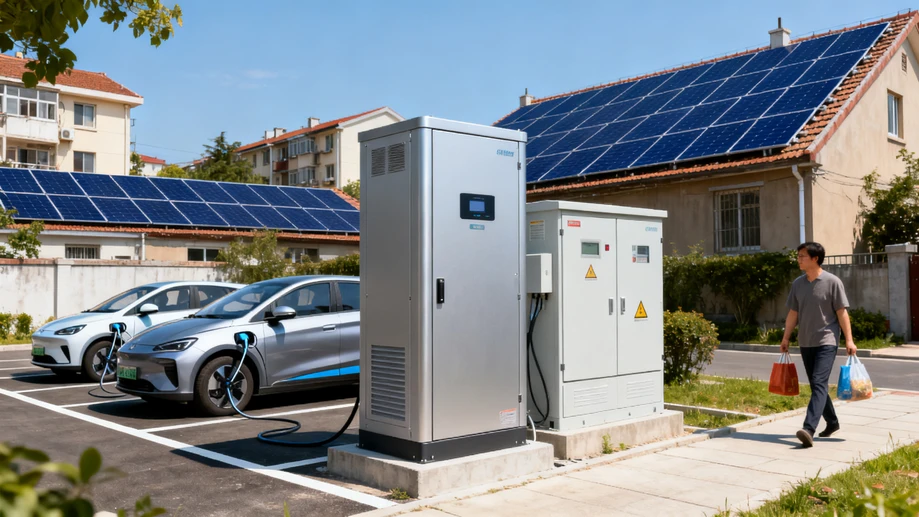
The most unsung player in this hidden local energy web is the retired electric vehicle battery storage cabinet sitting right next to the regular power distribution box at the edge of your apartment parking lot. Most people walk past these unassuming gray metal boxes every day and assume they are just old network equipment or power transformers, but in reality, they are packed with second-life electric vehicle batteries that once powered personal cars for five to eight years. When those car batteries drop to 70 to 80 percent of their original capacity, they can no longer deliver the full driving range car owners expect, but they still hold more than enough capacity to store excess grid power for neighborhood use. Utility companies fill these cabinets with cheap, surplus wind and solar power generated in the middle of the night when almost no one is using electricity, then discharge that stored power directly into the local grid during the 6 p.m. to 9 p.m. peak period when every household is running air conditioners, kitchen appliances, and home entertainment systems all at once. This simple setup alone cuts local peak grid pressure by up to 30 percent in many suburban areas, eliminating the need for temporary brownouts that were common on hot summer days a decade ago.
Even the 300-watt tiny solar panel you mounted on the edge of your balcony to power your outdoor string lights contributes far more to the local grid than you might guess. Most modern home solar systems are connected to the distributed grid metering network, so any power you do not use yourself automatically flows back into the local public power supply. On bright sunny weekends when you are out hiking all day and every panel on the surrounding apartment balconies and residential rooftops is pumping out free solar power, that collective surplus supply is often more than enough to power all the streetlights, water vending machines, and outdoor digital menu boards at nearby fast food restaurants for the entire afternoon. Many local utilities do not even advertise this system, because it works so reliably in the background that no administrative intervention is required. There are small towns in southern China where over 40 percent of all local daytime public power now comes from these tiny, individual residential rooftop solar panels, no large centralized solar farm required.
You are already actively supporting this hidden new energy system even if you do not own an electric car or a single solar panel at home. If your phone plan or home electricity plan offers an optional cheap off-peak data or power rate that kicks in after 11 p.m., that program is designed first and foremost to help absorb excess overnight wind power. Wind farms often generate far more power in the middle of the night than local residents can use, and without extra load to consume that surplus power, operators have to shut down entire turbine fleets and waste that perfectly clean free energy. When you set your dishwasher, washing machine, or electric car charger to run automatically at midnight, you are voluntarily acting as that extra load, soaking up otherwise wasted wind energy and cutting down the amount of coal-fired peaker power plants the grid has to turn on to balance out supply and demand the next evening. Many people do this just to save a few extra dollars on their utility bills, but their combined small choices add up to millions of tons of avoided carbon emissions every single year.
What makes this hidden new energy web so charming is that no one has to make huge, expensive life changes to participate in it, and no one has to learn complicated new rules to reap the benefits. The local government does not need to build massive fancy new public facilities, you do not need to buy a top of the line luxury electric vehicle to be part of the system, and every small regular choice you make to take advantage of low cost off peak power adds tangible value to your whole community. Over the next few years, more of these quiet, invisible new energy integrations will pop up all around you: public bench sides fitted with small hidden energy storage modules that can charge your phone for free, traffic light systems powered entirely by surplus residential solar power, and convenience store fridges that automatically shift to running on stored battery power during peak demand hours. None of these changes will feel shocking or out of place, they will just make your daily life a little bit cheaper, a little more stable, and a little bit greener, without you ever having to stop and think about it.