
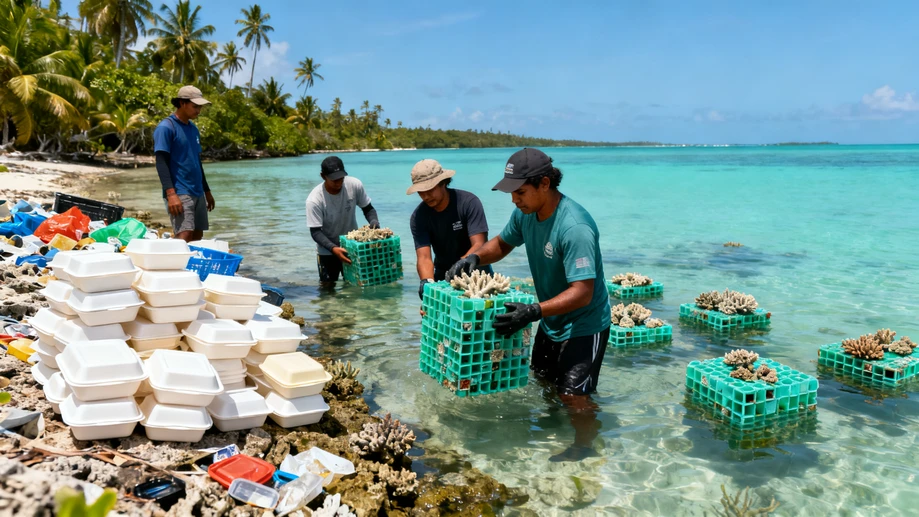
Who Knew Your Discarded Takeout Containers Could Help Rebuild Fading Coral Reefs
New community-led zero-waste initiatives around the world are turning overlooked daily trash into unexpected solutions for pressing ocean and land conservation challenges
Along the popular coastlines of Bali, Indonesia, groups of local volunteers have spent the past 18 months rolling out a low-cost, no fancy equipment project that has already restored more than 120 square meters of dead coral reef that was damaged by ocean warming and boat anchor damage over the past two decades. Instead of using expensive, heavy concrete artificial reef bases that cost more than 80 dollars each to produce and ship, the team collects fully cleaned food-grade polypropylene takeout containers that local residents and beachgoers leave in public waste bins. After sorting, removing food residue, sanitizing and compressing the light and durable plastic under low heat to shape it into porous, rock-like blocks, the volunteers drop them in shallow reef zones and attach small pieces of naturally growing local coral fragments to the surface. Local marine researchers who track the project say the coral survival rate on these recycled plastic bases is 37 percent higher than on traditional concrete bases, because the tiny evenly distributed pores on the compressed plastic surface give newly hatched coral larvae far more spots to attach and take root. The project has also cut the amount of single-use plastic that ends up washed up on local beaches by nearly 42 percent in the participating coastal villages, as more residents choose to sort their empty takeout containers to drop off at dedicated collection points for the reef project instead of tossing them in mixed waste bins.
Half a world away in the suburban outskirts of Nairobi, Kenya, a small group of local environmental activists has built a similarly low-tech project that turns the piles of used coffee residues discarded by 200 nearby cafes into nutrient-rich growing bricks for native urban reforestation efforts. Before the project launched three years ago, local city forestry teams only managed to get a 29 percent survival rate when planting native acacia trees along public roadside strips, because the thin, nutrient-poor local soil had no enough organic matter to support young saplings through the long dry seasons. The new coffee-organic brick mixes fully decomposed coffee grounds with shredded discarded cardboard from local delivery companies and a small amount of local termite mound soil to make a compressed, slow-release nutrition block that wraps around the roots of each sapling when it is planted. The brick breaks down slowly over the course of 12 to 18 months, feeding the young tree steadily through the dry season without needing expensive imported chemical fertilizers. So far the team has distributed more than 7,200 of these bricks to local community tree planting groups, pushing the native sapling survival rate up to 81 percent, while also creating 121 steady part-time jobs for low-income residents from nearby informal settlements who work to collect coffee waste, process the bricks and tend to newly planted trees.
These two independent community projects have caught the attention of global environmental observers recently, not because of any new breakthrough scientific invention, but because they prove that small, daily household waste sorting actions from ordinary people can create far more tangible conservation impact than most people ever imagine. For decades, most public environmental advocacy narratives have told people that meaningful environmental protection requires large donations, full-time volunteer work or big corporate policy shifts, leaving many regular people feeling that their small individual actions do not make any difference. Data collected by a global non-profit that tracks community zero waste programs shows that a 12 percent rise in proper household sorting of rigid plastic food containers and organic coffee waste across participating regions last year provided these small local conservation projects with 28 percent more free usable raw materials, cutting their total operating cost by more than 12 million dollars and allowing them to expand their work to 11 new regions that had no budget for formal conservation projects before.
A recent public opinion survey conducted in Porto, Portugal across 2,400 local residents found that 68 percent of respondents had no idea that their regularly discarded daily items could be turned into such practical conservation tools before local community organizations launched small neighborhood collection points for clean empty takeout containers and used coffee grounds last year. The city also rolled out a simple reward system for participants: residents who drop off five fully cleaned empty takeout containers at the local community collection point can get a 2 euro voucher to use at the weekly local farmers market, and residents who bring a full small bucket of used coffee grounds from their home coffee makers can get a 30 percent discount coupon at the neighborhood independent bakery. The survey data shows that community waste sorting participation rates in these pilot neighborhoods jumped three times higher than before the reward system launched, with many residents saying they feel far more connected to local conservation work now that they can see exactly what their sorted waste is used for in the community.
At the moment, 17 different coastal and suburban communities across 12 countries have requested free guidance from the original Bali and Nairobi project teams to roll out their own local versions of these low-cost conservation projects. No special expensive manufacturing equipment is required to launch either project, and all the raw materials are already being thrown away as waste by local households every single day. Conservation advocates point out that these growing community movements serve as a clear reminder that global environmental protection does not always need to wait for far-off, expensive futuristic technology solutions. Most of the time, all people need to do is spend 30 extra seconds a day sorting their waste properly, to turn items that would otherwise end up rotting in landfills or floating in the ocean into practical, meaningful tools that help restore the natural world right outside their own front doors.