
Who Knew Picking Up 3 Random Pieces Of Trash On Your Daily Walk Could Rewild An Entire City Block?
A tiny, unpublicized community challenge launched last spring in the coastal town of Seaside, Oregon has delivered far bigger environmental benefits than anyone could have imagined, turning once-overlooked public spaces into thriving native pollinator habitats.
The idea first popped up in early March 2023, when local part-time park ranger Lila Marlow posted a casual note in her neighborhood’s 3000-member local community group online, complaining that regular deep-cleaning volunteer days never seemed to get rid of all the tiny, scattered litter embedded in the edges of local walking trails. She proposed a nearly zero-effort challenge: instead of asking people to haul heavy garbage bags and spend three full hours volunteering, every person out for a daily walk, dog walk, or school run could pick up exactly three small pieces of trash they happened to spot, tuck them in a pocket or existing bag they were already carrying, and drop them in any public trash can along their route. No sign-ups, no scheduled meetings, no required hours of commitment. The first week, only 17 people posted photos of their tiny collected trash hauls in the group, ranging from crumpled candy wrappers and bottle caps to tiny fragments of broken plastic straws and crumbs of expanded polystyrene that had blown off nearby delivery trucks. No one involved expected the tiny, low-stakes action to turn into anything more than a minor cleanup for their most popular waterfront trail.
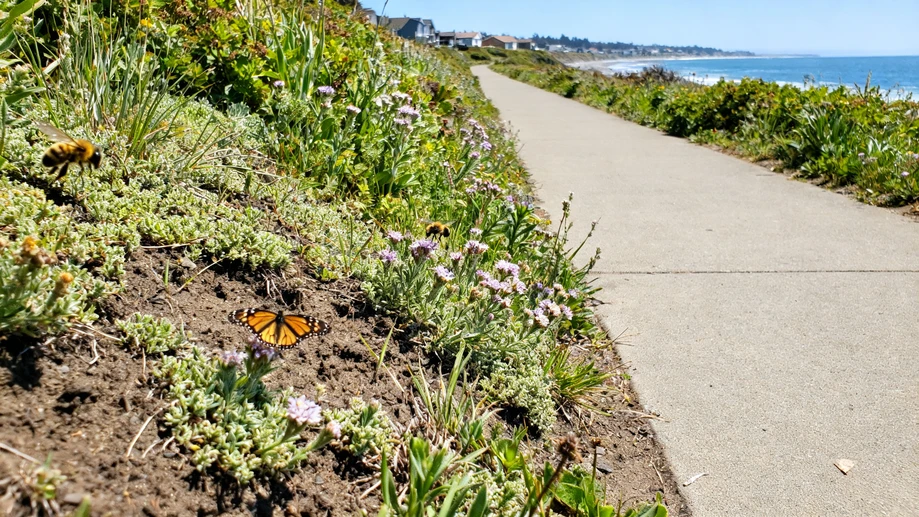
By the end of the summer, though, residents started noticing odd, wonderful changes in the spots they had all been clearing of tiny litter. The thin layer of broken plastic fragments that had covered the topsoil along trail edges for more than a decade was completely gone, and no longer blocked sunlight from reaching the dormant native seeds that had been sitting in the local soil seed bank for years. Wild native coastal clover, purple lupine, and tiny beach asters started sprouting unprompted from ground that the local public works department had previously written off as completely unsuitable for native plant growth, with no seeding, no soil amendment, and no municipal budget allocated for the work. Where there had previously been nothing but packed bare dirt and scattered litter, clusters of native wildflowers bloomed for the first time in local memory, drawing back local bumblebee species that had not been spotted in town for more than seven years. Park staff later calculated that the 3-trash challenge had achieved the exact same rewilding results that a previously planned 120,000 dollar city habitat restoration project was designed to deliver, without spending a single dollar of public funds.
Word of the odd, low-effort success spread to 11 neighboring coastal towns over the next six months, and more than 7200 local residents signed on to the casual unregulated challenge by the start of 2024. Over the full 12 months the program ran, participants collectively picked up more than 187,000 pieces of tiny scattered litter across local public spaces, according to a crowdsourced tally residents put together by sharing their finds on the local community social media pages. As of this month, 27 previously overlooked unused patches of land, ranging from 10-foot wide roadside medians to forgotten corners of neighborhood parks, have spontaneously grown into fully functional native pollinator habitats that support 22 different species of native wild plants, 17 species of local pollinating insects that were previously thought to be locally extinct, and 6 species of ground-nesting songbirds that had abandoned the town when litter made it too dangerous for them to dig nests in the dirt. Local elementary school students even launched their own unofficial wildflower tracking project, counting new blooms on their walk home from school every weekday, to document how fast the new native plant populations are spreading across town.
A team of independent environmental researchers from a nearby public university spent 10 months observing the program, and noted that its unprecedentedly high participation rate came almost entirely from the fact that it placed zero burden on participants. Traditional community conservation volunteer programs in the area usually struggle to get more than 40 or 50 regular participants, as most people do not have extra free time to set aside for scheduled volunteer shifts. But more than 90 percent of the people who joined the 3-trash challenge never even considered themselves environmental volunteers, and many did not even realize they were contributing to a city-wide rewilding project. Runners training for local 5K races would pause for 10 seconds mid-jog to pick up three bits of plastic, parents walking their kids to elementary school would tuck a few stray wrappers in their kid’s backpack, and people out walking their dogs would grab a few bits of broken trash while their pet stopped to sniff at grass. The researchers calculated that this type of completely unstructured, low-stakes daily action had a participation rate 17 times higher than traditional structured conservation volunteer events.
The simple model is now being adopted by communities in 9 different U.S. states, as local organizers realize that large, expensive, government-run environmental projects are not the only way to make major improvements to local urban nature. Seaside residents recently launched a follow-up casual challenge, asking anyone who passes a patch of invasive English ivy along their regular route to pluck one small vine from the ground if they happen to have 10 seconds to spare. No one has set a formal target for the new challenge, but early reports show that the total amount of invasive ivy pulling done by casual participants over the past two months has already outpaced the work of the city’s paid seasonal invasive removal team last year. For local residents, the project has completely shifted their view of what community environmental action can look like: they do not need to wait for grant funding, for official city plans, or for special events to make the local ecosystem healthier. Small, effortless choices woven into the most mundane parts of daily life, made by hundreds of ordinary people, can add up to deliver changes far more dramatic than anyone ever could have predicted.