
Did You Know The Moon Is Quietly Wiggling Your Tap Water Every Single Day
A crowd-sourced geoscience observation effort run entirely by ordinary residents in 12 small coastal towns has picked up tiny, consistent lunar effects that have never been documented for everyday household water systems before
Most people learn in primary school that the gravitational pull of the Moon is the primary force driving the twice-daily tides that move up and down the world’s shorelines, and many also know this faint tug from 384,000 kilometers out in space affects far more than just the open ocean. But until earlier this year, no group had clearly linked this familiar cosmic force to the water that flows directly out of kitchen and bathroom taps across residential neighborhoods. The project started last winter, when a group of amateur stargazers and local community volunteers in coastal towns of Maine gathered online to brainstorm low-cost observation ideas that did not require fancy professional tools, and eventually landed on a plan to map tiny pressure shifts in local water supply lines to spot hidden leaks that the municipal maintenance team had not yet found.
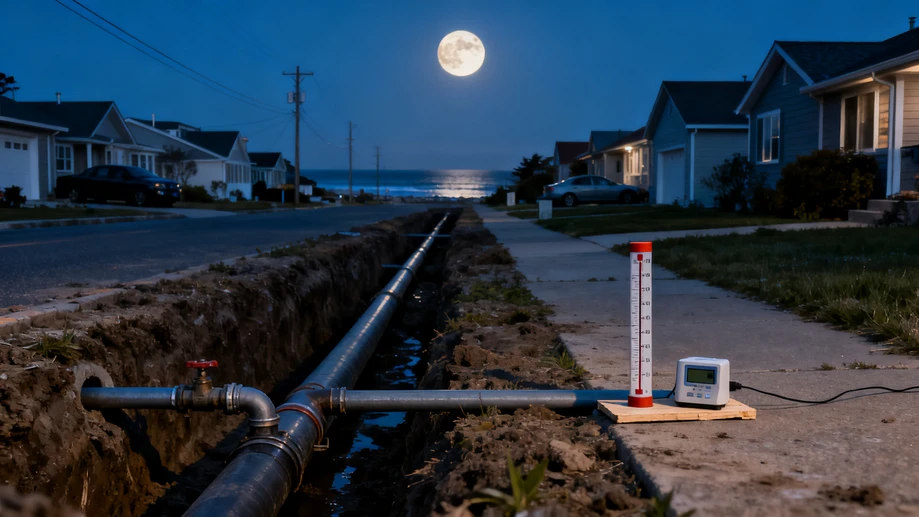
The volunteers spent three weeks assembling 19 high-sensitivity water level sensors sourced from common consumer hardware stores, installed them at branching points of the municipal water network, and also mounted 7 extra units on the incoming water line inside their own homes, then logged 24/7 readings for 97 consecutive days to eliminate all possible interfering factors. After they ruled out fluctuations caused by morning and evening peak water use, routine pump adjustments at the local water treatment plant, and minor temperature shifts in the underground pipes, every single sensor picked up a recurring tiny shift that repeated every 12 hours and 25 minutes, a cycle that lines up perfectly with the exact timing of the Moon’s transit over the local meridian. What the team eventually confirmed is that solid bedrock across the entire region flexes roughly 30 centimeters up and down every day under lunar tidal force, and this slow deformation squeezes the shallow groundwater aquifer that feeds the entire town’s water supply, creating a minuscule pressure ripple that travels all the way through pipes to every household on the network.
Almost every volunteer in the group had funny personal anecdotes that lined up with this new finding, once they cross-referenced their old memories against the logged data. A bookstore owner recalled that for years, she would occasionally hear a faint, soft gurgle inside the old copper pipes behind her break room sink in the middle of the night, and she had always blamed the noise on trapped air or aging pipe fixtures, with no idea the tiny sound was triggered by the Moon’s slow tug pulling at the groundwater under the town. A part-time barista who ran a small neighborhood coffee shop said that sometimes when she pulled a standard espresso shot, the flow of water through the machine would shift by a barely noticeable fraction of an ounce for a split second, and she had spent hundreds of dollars on maintenance checks for her high-end machine over the past two years trying to fix what she thought was a minor calibration error, only to find there was nothing wrong with it at all.
The small group later expanded their observation range, placing extra sensors in the man-made pond at the town public park, in two large outdoor farm tanks used to store rainwater, and even inside 11 home aquariums owned by local residents, and every single test setup picked up the same faint lunar-driven water shift. Their logs also showed that the amplitude of the tiny water level and pressure jump is roughly 40 percent higher on nights with a full moon, and 20 percent lower around the new moon phase, matching the combined gravitational effect of the Sun and Moon that creates spring and neap tides in the ocean. The group has even posted a simple 3-step guide online for any ordinary person to test this effect at home without any special equipment, by placing a full glass of still water on a vibration-free surface away from foot traffic, sticking a tiny piece of glitter on the water surface right near the rim, and recording slow motion footage with a standard phone camera for three to four hours to catch the glitter shifting back and forth in sync with the Moon’s pull.
None of the observation work required dedicated professional lab space or million-dollar research grants, and all of the raw data the team collected has been submitted to the U.S. Geological Survey’s community geoscience database for public use. Researchers who reviewed the dataset noted that the most charming part of this discovery is how it shatters the common idea that cosmic events happening hundreds of thousands of kilometers away are completely disconnected from small, mundane daily moments. People often think the Moon only matters for night sky viewing, tidal surfing, or old folklore tales, but this tiny, unnoticed effect means every glass of water you pour at home carries a faint, daily signature left by our nearest celestial neighbor, a quiet little connection between your kitchen sink and the rest of the solar system that has existed for billions of years.