
Have You Ever Noticed The Tiny Cosmic Dust Hiding On Your Kitchen Window Sill
Global citizen science observation data confirms that countless tiny extraterrestrial particles settle on Earth every year, and they may have stayed around your home without you ever noticing
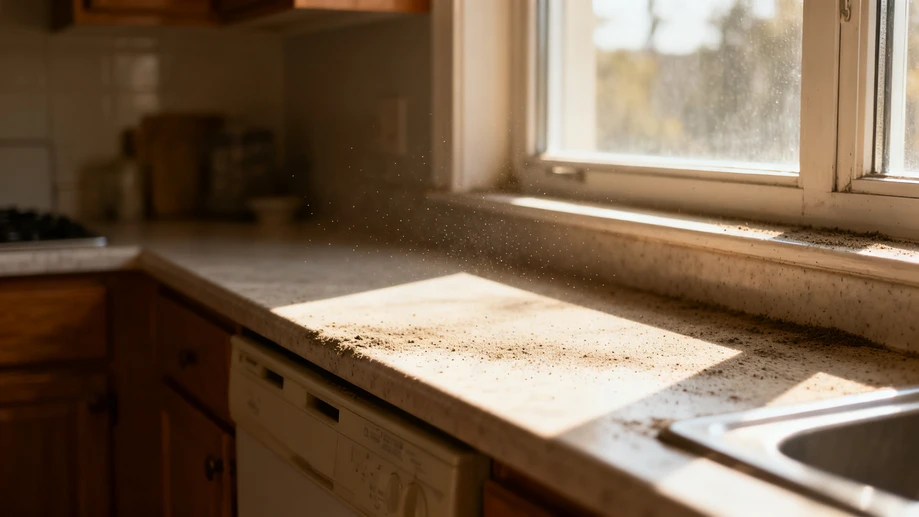
Most people have had the experience of wiping a thin layer of gray dust off their kitchen window sill after a week or two of no deep cleaning, and almost all of us would take that dust for a mix of roadside exhaust residue, seasonal pollen, fine sand blown in from suburban green belts, and tiny particles shed from old furniture surfaces. What barely anyone knows is that among those millions of tiny specks you wiped off with a rag, there are a handful of particles that do not originate anywhere on Earth at all. These tiny interstellar and interplanetary fragments are too small for the naked eye to identify individually, with most measuring no more than one tenth of the diameter of a human hair, and hundreds of them clustered together only form a faint gray dot that can barely be distinguished against a white background. They do not come from the dramatic fireball meteorites that streak across the night sky, but are the fine debris shed by comets when they pass close to the sun, or the leftover fragments from millions of years of constant collisions between massive asteroids in the asteroid belt between Mars and Jupiter.
Over the past three years, a loose team of amateur astronomy fans and amateur geographers scattered across 17 countries carried out a long-term tracking survey that did not rely on large professional research facilities at all. The team members agreed on a unified simple sampling method, requiring each participant to take a brand new, static-free microfiber cloth soaked in pure distilled water, wipe the outer edge of the window sill on a floor higher than the 10th floor that had not been cleaned for at least three months, seal the cloth in a sterile ziplock bag, and then send the sample back to the unified distribution center for classification and observation with ordinary household optical microscopes. After collecting more than 1200 valid samples from regions covering the Arctic Circle, tropical volcanic islands, mid-latitude inland plains and subtropical mountain towns, the team came to a surprising and reliable conclusion: every square meter of outdoor window sill surface can accumulate 3 to 8 identifiable extraterrestrial dust particles every six months, and the total mass of such cosmic dust that falls on the entire Earth every year is close to 10,000 tons.
The journey these tiny dust particles take before landing on your window sill is far more magical than most people can imagine. Most of them have drifted in the solar system for at least several million years, and some even predate the formation of the Earth itself. When they are captured by Earth's gravity and fall into the atmosphere, their initial entry speed can reach 30 to 70 kilometers per second. The violent friction with atmospheric molecules instantly heats the surface of the particles to more than 1500 degrees Celsius, burning all the light impurities wrapped on the surface, and forming a smooth, glassy fused outer layer after rapid cooling. When they fall to a height of about 12 kilometers above the ground, their falling speed slows down to the same level as ordinary terrestrial dust, and they then follow the global atmospheric circulation to drift for several weeks to several months, travel across thousands of kilometers of land and ocean, and finally fall to the ground with the wind, or be carried down to the surface by raindrops and snowflakes. You may have already touched these cosmic fragments inadvertently: they could be mixed in the fine soil you run through your fingers when planting potted plants on the balcony, suspended in the clear spring water you drink when hiking in the mountains, or even mixed in the fine dust that floats up when you flip through a decades-old book on your bookshelf.
Anyone who is interested can try to find these hidden cosmic dust particles at home without buying any expensive professional equipment. You only need to prepare a pack of unused fine quantitative filter paper, a bottle of pure distilled water, and an ordinary household optical microscope with a magnification of more than 200 times. Gently wipe the uncleaned outer edge of the high-rise window sill with the filter paper soaked in distilled water, then lay the filter paper flat on a clean tray to dry naturally in a place away from direct sunlight and wind. After the filter paper is completely dry, place it under the lens of the microscope and move the sample slowly at the lowest magnification, and you will have a probability of more than 60% to find several tiny, bright metallic spherical particles that are completely different from the irregular shape of terrestrial mineral fragments. Each of these small spheres you find has witnessed the changes of the solar system for hundreds of millions of years, and has crossed a distance of hundreds of millions of kilometers to meet you on an ordinary Tuesday afternoon.
For a long time, most people have regarded astronomy and geoscience as fields that are far away from daily life, and only accessible to people who own large observatory telescopes or deep canyon exploration equipment. But this simple citizen science survey tells us that the traces of the vast universe are not hidden in distant places that are difficult to reach, but scattered in every corner of your daily life. You do not need to spend a lot of money to buy professional equipment, do not need to take a long-distance flight to a remote observation base, and you do not even need to go out of your own community to come into contact with traces that come from outside the Earth. The romance of the universe has never been reserved for a small number of professional researchers, it is quietly hidden on the window sill you are used to wiping, on the blades of grass you step over when walking the dog, and in the fine air you breathe every time you open the window.