
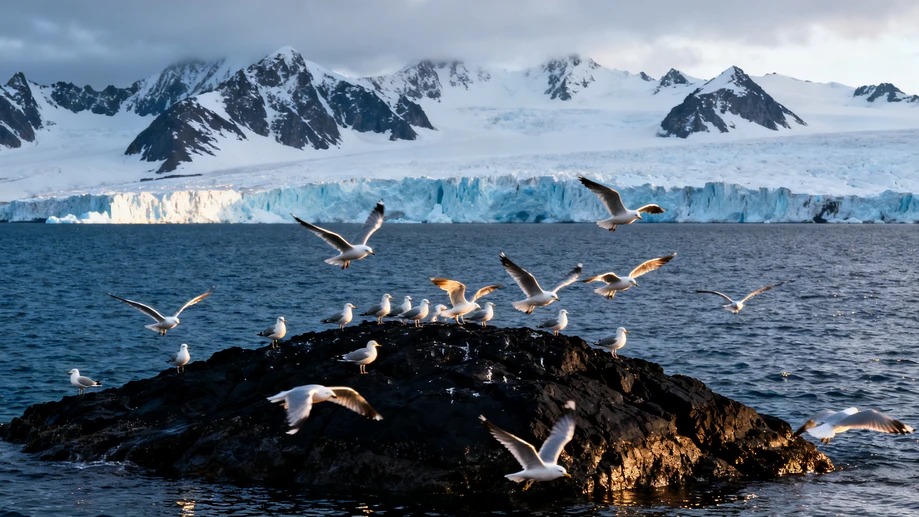
The Arctic's Unexpected New Residents: Seagulls Moving North at an Alarming Rate
Discover how climate change is rewriting migration maps as birds colonize thawing polar regions
For millennia, the stark white expanse of the High Arctic remained a no-go zone for most bird species, its frozen tundra and icy seas dominated exclusively by hardy specialists like snow buntings and ivory gulls. That's changing faster than scientists ever predicted. Satellite data reveals seagulls—those ubiquitous coastal scavengers—are now establishing breeding colonies 500 kilometers farther north than recorded just two decades ago. Researchers tracking their movements describe flocks following retreating sea ice like pioneers claiming new territory, exploiting newly exposed nesting cliffs and feeding grounds where glaciers once stood. This rapid colonization demonstrates nature's scramble to adapt as the poles warm four times faster than the global average.
What's driving this feathered invasion? Thawing permafrost creates mudflats teeming with insects and crustaceans, while melting glaciers release nutrient-rich sediment into coastal waters. Marine biologist Dr. Lena Johansen explains: "Cold-water species are vanishing, but warmer currents bring mackerel and herring northward. Seagulls capitalise on this buffet." Recent drone surveys show gull populations around Svalbard have tripled since 2010, their raucous cries now echoing where only howling winds once prevailed. Indigenous communities report seeing the birds year-round rather than seasonally—a dramatic behavioral shift attributed to newly ice-free winters.
The ecological ripple effects are profound. Fragile tundra vegetation gets destroyed by trampling nests and acidic guano deposits. Arctic foxes, once apex predators of bird colonies, now compete with gulls for eggs. Most alarmingly, migratory species like little auks face aggressive displacement from prime nesting sites. Conservationist Arnie Nattak describes finding exhausted auks drowned beneath waves after being chased for hours by gulls stealing their fish. "It's like watching gatecrashers overwhelm a private party," he observes, noting that 14 shorebird species now show declining hatchling success near gull settlements.
Scientists employ innovative methods to map this ecological upheaval. Tiny GPS backpacks on gulls transmit real-time flight paths, revealing journeys from Scotland to Franz Josef Land in under two weeks. Thermal cameras detect nests hidden in rock crevices, while AI analysis of decades-worth of expedition photos confirms the speed of change—images from the 1980s show zero gulls where thousands now congregate. "They're ecological opportunists," states ornithologist Kenji Yamamoto. "Give them open water and food sources, and they'll transform ecosystems within years."
Interestingly, urban adaptability gives gulls an edge. Those accustomed to scavenging from landfills or fishing boats transfer these skills to Arctic whaling stations and research outposts. Recent footage captured gulls dropping clams onto heated rooftops in Longyearbyen to crack shells—a behavior copied from city-dwelling relatives who use asphalt roads. This behavioral plasticity suggests further adaptation as human activity expands northward with shipping routes and resource extraction.