
Ever Wondered How Ants Build Their Underground Empires?
The Architectural Marvels Beneath Our Feet
We walk over them every single day, often completely oblivious to the intricate, bustling metropolises hidden just inches below the surface of our gardens, parks, and sidewalks. Ant colonies are engineering masterpieces, rivaling the complexity of any human city in terms of structure, functionality, and social organization. From sophisticated ventilation systems that rival air conditioning to waste disposal areas that keep the nest hygienic, these tiny architects construct entire subterranean kingdoms using nothing but instinct, teamwork, and their own bodies as tools. The sheer scale and efficiency of their underground networks are a testament to millions of years of evolutionary refinement, creating stable, climate-controlled environments perfect for raising young, storing food, and sustaining colonies that can number in the millions.
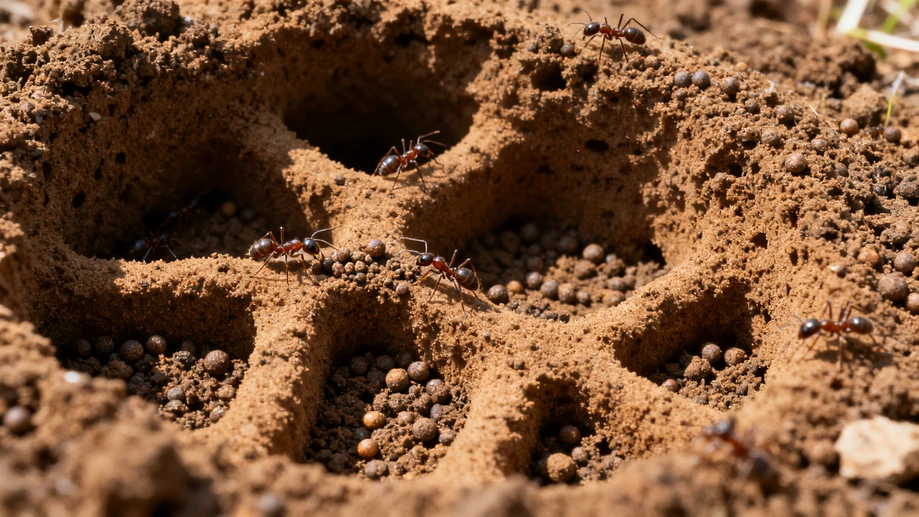
The construction process begins long before a single grain of soil is moved. Scout ants meticulously survey the terrain, assessing factors humans wouldn't even consider: soil composition, moisture levels, temperature gradients, and proximity to food and water sources. Once the perfect spot is identified, typically near but not too near a reliable resource, the real work commences. Worker ants, equipped with powerful mandibles, start excavating tiny particles of soil. They don't just dig randomly; they methodically enlarge the initial entrance tunnel, creating a narrow shaft that spirals downwards. This spiral design isn't accidental; it provides structural stability, preventing collapses, and offers a gentle gradient for hauling materials. Imagine a microscopic, spiraling highway built grain by grain, designed for maximum strength and traffic flow by creatures smaller than your fingernail.
As the colony grows, so does its complexity. Tunnels branch out like subway lines, connecting specialized chambers with distinct purposes. Deep within lies the nursery, where nurse ants meticulously tend the eggs, larvae, and pupae, constantly moving them to chambers with the ideal temperature and humidity. Nearby, specialized granaries store seeds and other gathered food, while other chambers act as rubbish dumps or cemeteries, strategically placed to keep waste away from vital areas, maintaining crucial sanitation. The central hub is often the queen’s chamber, a larger space where the colony's reproductive heart resides, continuously producing new members. Perhaps most fascinating are the ventilation shafts – narrow tunnels extending upwards towards the surface, cleverly utilizing temperature differences to create passive airflow that draws fresh air down and expels stale, carbon dioxide-rich air up, effectively air-conditioning the entire nest.
All this construction relies on an extraordinary level of decentralized cooperation. There's no single architect ant directing operations. Instead, each worker ant follows simple rules based on pheromone trails left by its nestmates. When an ant finds a good spot to dig or encounters a structural problem, it deposits specific chemical signals. Other ants encountering these trails are stimulated to follow, reinforce, or alter their behaviour accordingly. This creates a self-organizing system where complex, highly functional structures emerge from the collective actions of thousands of individuals, each acting on local information. It's a powerful, organic form of communication and problem-solving that allows the colony to adapt its structure dynamically to changing needs, threats, or environmental shifts, like heavy rain or root growth. The nest is constantly being remodeled and expanded, a living, breathing structure.
What can we learn from these tiny subterranean engineers? Ant construction principles inspire biomimicry – the design of human technologies based on natural models. Studying their efficient tunnel networks, which minimize travel distance while maximizing connectivity, could inform the design of more efficient transportation or communication networks. Their passive ventilation systems offer insights for sustainable building design, potentially reducing energy consumption. Even their decentralized, swarm-like decision-making processes are being studied to improve algorithms for robotics, logistics, and disaster response coordination. The humble ant colony demonstrates that sophisticated engineering solutions don't always require complex blueprints or advanced tools; sometimes, they emerge from the collective intelligence and tireless effort of a vast, well-coordinated community working towards a common goal right beneath our feet.