
Why Do Fireflies Glow in Perfect Sync, and What If We Could Copy It?
Across Southeast Asia and the Appalachian Mountains, fireflies are putting on the most sophisticated light show on Earth, and engineers are racing to understand how they do it
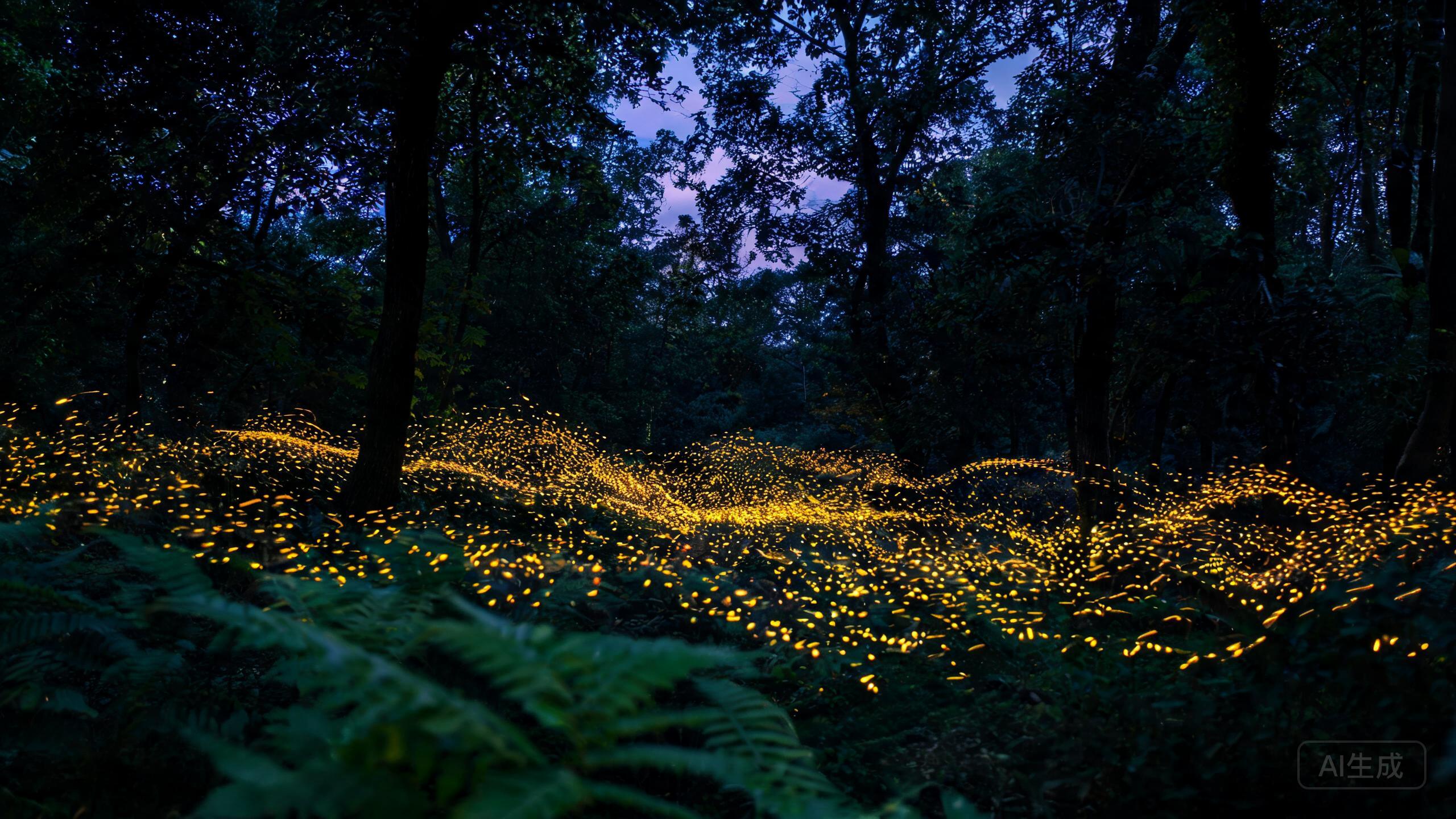
If you have ever stood on the banks of a tidal river in Thailand's mangrove forests on a warm June evening, you have likely witnessed something that feels more like magic than biology. As the sky fades from orange to deep indigo, the first few yellow-green sparks begin to flicker in the shadows beneath the trees. Then, almost imperceptibly, something extraordinary happens. Instead of the random, scattered blinking you might expect from a field full of fireflies, every single insect begins pulsing in perfect unison. For three seconds, the entire forest glows as one living lantern. Then darkness. Then another synchronized pulse, rippling through the canopy like a biological heartbeat. This is not a trick of your eyes, and it is not a local legend exaggerated by enthusiastic tour guides. It is one of the most baffling behaviors in the entire animal kingdom, and scientists have spent the better part of a century trying to figure out how thousands of individual insects with brains smaller than a grain of rice manage to coordinate their light output with millisecond precision.
The phenomenon of synchronous firefly flashing was first documented by Western scientists in the 1960s, though local communities in Malaysia and Thailand had observed it for generations. There are actually only a handful of firefly species in the world that display this behavior, and they are scattered across surprising geographies. The most famous populations include Photinus carolinus in the Great Smoky Mountains of Tennessee and North Carolina, where thousands of visitors gather each June to watch hillsides pulse with waves of light, and several species along the river systems of Southeast Asia, where the displays can be so bright that fishermen have historically used them to navigate waterways after dark. What makes these displays so remarkable is not just the beauty, but the mathematical precision underlying them. When researchers set up high-speed cameras and measured the flash timing of individual fireflies within these swarms, they found that the synchronization is not approximate or loosely coordinated. It is exact. Individual fireflies adjust their internal flash timing until they match the swarm's collective rhythm, creating a biological oscillator network that would make any electrical engineer jealous.
To understand how this works, you first need to understand why fireflies flash at all. Fireflies produce light through a chemical reaction in specialized organs in their abdomens, a process called bioluminescence. An enzyme called luciferase acts on a compound called luciferin in the presence of oxygen, magnesium, and energy-storing molecules, producing a pulse of cold light with nearly 100 percent energy efficiency. No heat is wasted, which is why bioluminescence is sometimes called cold light. Each species of firefly has its own distinct flash pattern, a biological Morse code that allows males and females of the same species to recognize each other in the dark while ignoring flashes from other species. The typical pattern for most firefly species involves a male flashing a specific sequence while flying, and a female waiting on vegetation and responding with her own species-specific flash if she is interested in mating. But in synchronizing species, something very different is happening. Instead of using flashes to stand out from the crowd, these fireflies are using flashes to blend into it, creating a collective signal that is far more visible to distant females than any individual male could achieve on his own.
The mechanism behind this synchronization was finally cracked in the early 2020s by a combination of field biologists and mathematicians who realized that firefly swarms behave like a network of coupled oscillators, a concept that physicists had been studying in other contexts for decades. Each firefly has an internal biological clock that determines when it flashes, and that clock can be reset by seeing a flash from another firefly. When a firefly sees a neighbor flash, it slightly adjusts its own timing to flash a little bit sooner, moving its rhythm closer to what it just observed. If you have thousands of fireflies all doing this simultaneously, constantly adjusting their timing based on the flashes they see around them, the entire system naturally converges on a single shared rhythm. This is the same mathematical principle that causes pendulum clocks mounted on the same wall to eventually swing in sync, or that allows thousands of metronomes placed on a movable platform to tick in unison. The technical term is phase coupling, and it turns out that nature discovered it long before humans did.
What has researchers truly excited in 2026 is not just understanding how fireflies synchronize, but figuring out how to apply those principles to human technology. A team at MIT published a paper earlier this year demonstrating a network of tiny robots that use flashing LED lights to coordinate their movements in exactly the same way fireflies do, without any central controller or pre-programmed timing. Each robot adjusts its behavior based only on the light signals it detects from its immediate neighbors, yet the entire swarm eventually coordinates to perform complex tasks like area mapping and obstacle avoidance. The implications for swarm robotics are enormous. Current drone swarms require centralized communication and precise GPS coordination, which makes them vulnerable to signal jamming and limits their usefulness in environments where GPS is unavailable, like underwater exploration or inside buildings. A firefly-inspired coordination system could allow robot swarms to operate autonomously with minimal communication bandwidth, making them more robust and scalable.
The applications extend far beyond robotics. Telecommunications engineers are exploring whether firefly-inspired synchronization could improve the efficiency of wireless sensor networks, where thousands of tiny devices need to coordinate their data transmission without draining their batteries through constant communication. Power grid specialists are studying whether the same phase-coupling principles could help stabilize distributed renewable energy sources, where hundreds of solar panels and wind turbines need to feed power into the grid at precisely synchronized frequencies. Even medical researchers have taken notice, with several teams now investigating whether cardiac pacemakers could be redesigned to use firefly-like coordination, allowing multiple implanted devices to synchronize their timing without direct electrical connections. The humble firefly, it turns out, may be sitting on solutions to some remarkably complex engineering challenges.
Unfortunately, the same human expansion that is driving demand for these technologies is also threatening the fireflies that inspired them. Synchronous firefly species are among the most vulnerable to habitat disruption because their mating displays depend on dense populations. When forests are fragmented by roads and development, the continuous swarms needed for synchronization break into smaller, isolated groups that can no longer maintain their collective rhythm. Light pollution from nearby cities creates an even more insidious problem, as artificial lights interfere with the fireflies' ability to see each other's flashes, disrupting the visual coupling that makes synchronization possible. The famous firefly tourist sites in Southeast Asia have reported dramatic declines in display intensity over the past decade, and even the Great Smoky Mountains population, carefully protected within a national park, faces pressure from increasing visitor numbers and surrounding development. Several synchronous firefly species are now being considered for endangered status, which would make them the first fireflies ever formally protected under conservation law.
Perhaps there is a lesson here that goes beyond the purely scientific. In a world that often celebrates individual achievement and competition, fireflies remind us that there are problems so complex that no individual can solve them alone, and that sometimes the most brilliant strategy is not to stand out from the crowd, but to fall into step with it. A single firefly flashing in isolation is easy to miss, even for a mate searching specifically for that signal. But ten thousand fireflies flashing as one create a beacon visible from hundreds of meters away, cutting through the visual noise of the forest with a clarity that no individual could achieve. The mathematics of synchronization tell us that this is not just a poetic metaphor. It is a physical law, as real as gravity, and it operates in everything from the cells of your heart to the neurons of your brain to the fireflies glowing in a darkened forest on a summer night. The next time you see a field of fireflies, take a moment to watch not just the individual sparks, but the patterns that emerge from the whole. You might be witnessing one of nature's oldest and most elegant solutions to a problem that humans are only just beginning to understand.