
Could Deep-Sea Hydrothermal Vents Hold the Secret to How Life First Began on Earth?
Scientists exploring the crushing darkness of the ocean floor are finding chemical signatures that mirror the very first steps of life, and the implications reach far beyond our own planet
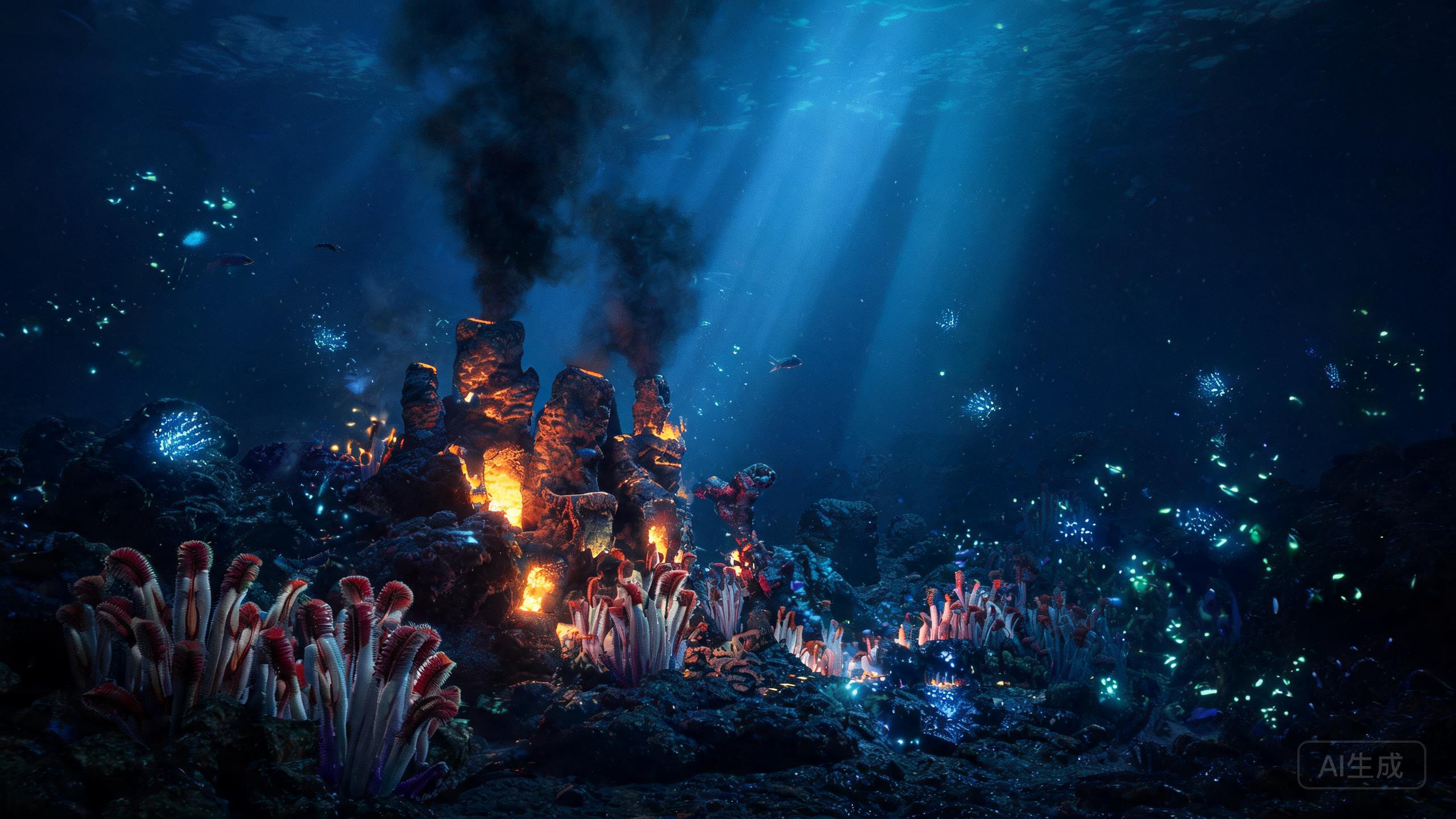
Imagine descending through two and a half kilometers of ocean water, past the point where sunlight fades to an inky blackness so complete that your eyes become useless decorations. The pressure at this depth is roughly 250 times what you feel at the surface, enough to crush a standard submarine like an aluminum can. The temperature hovers just above freezing. And yet, in this seemingly lifeless void, the seafloor is tearing itself open. Cracks in the Earth's crust allow seawater to seep deep into the mantle, where it is superheated by magma to temperatures exceeding 400 degrees Celsius. This scalding water, now loaded with dissolved minerals leached from the rock below, erupts back up through chimney-like structures made of metal sulfides, creating towering black plumes that billow into the cold abyss like smokestacks of some subterranean factory. These are hydrothermal vents, and since their accidental discovery in 1977 by a team of geologists exploring the Galapagos Rift, they have been rewriting our understanding of where life can exist, how it might have started, and whether we are alone in the universe.
The reason hydrothermal vents have become the leading candidate for the cradle of life comes down to a deceptively simple problem. Life, as far as we understand it, requires three things: a source of energy, a supply of raw chemical building blocks, and a mechanism to concentrate and organize those building blocks into the complex molecules that make living cells possible. On the early Earth, roughly four billion years ago, the surface was a violent and inhospitable place, bombarded by asteroids, blasted by intense ultraviolet radiation, and constantly disrupted by volcanic activity. The classic idea that life began in a warm shallow pond, famously proposed by Charles Darwin in a letter to a colleague in 1871, has always struggled to explain how the necessary chemical reactions could proceed with enough concentration and stability to produce anything as complex as a living cell. Hydrothermal vents, by contrast, offer all three requirements in a single location. They provide a steady flow of chemical energy in the form of reduced compounds like hydrogen sulfide and methane bubbling up from the vent fluid, they supply a rich cocktail of carbon, nitrogen, sulfur, and trace metals leached from the ocean crust, and they create natural mineral chambers that can trap and concentrate molecules in much the same way a cell membrane does today.
The specific type of vent that has scientists most excited is not the dramatic black smoker variety that shoots superheated fluid into the ocean, but a gentler, cooler cousin known as an alkaline hydrothermal vent. These vents, first discovered in the year 2000 at a site called Lost City near the Mid-Atlantic Ridge, operate at a much milder 40 to 90 degrees Celsius. Instead of building chimneys from metal sulfides, they form massive white towers of calcium carbonate, some reaching 60 meters tall, that look almost like the spires of a submerged cathedral. The fluid emerging from these vents is highly alkaline, with a pH around 9 to 11, while the surrounding early ocean is thought to have been mildly acidic, with a pH around 5 to 7. This pH gradient, the natural difference in acidity between the vent fluid and the seawater, creates a proton gradient across the mineral walls of the vent chimneys. And here is the key insight that has energized the entire field of origin-of-life research, proton gradients are exactly the mechanism that all living cells use today to generate energy. In modern biology, this process is called chemiosmosis, and it is universal across every branch of the tree of life, from bacteria to humans. The fact that this same mechanism exists naturally in the geology of hydrothermal vents suggests that life did not have to invent it from scratch. It simply had to learn to exploit a gradient that was already there.
The experimental evidence supporting this theory has been building steadily over the past decade, and several breakthroughs in 2026 have added significant weight to the argument. In a series of experiments conducted at research institutions in Japan, Germany, and the United States, scientists have recreated the conditions inside alkaline hydrothermal vents in laboratory settings and observed some remarkable spontaneous chemistry. When they pump warm alkaline fluid containing dissolved hydrogen and carbon dioxide through mineral chambers made of iron and nickel sulfides, compounds that are structurally identical to the active sites of some of the most ancient enzymes still used by living cells today, they find that carbon dioxide is spontaneously reduced into simple organic molecules including formate, acetate, and even trace amounts of pyruvate. These are the exact metabolic intermediates that sit at the base of every known metabolic pathway. The minerals are acting as catalysts, performing the same chemical transformations that enzymes perform in modern cells, but without any biological machinery whatsoever. The reaction proceeds at temperatures between 50 and 70 degrees Celsius, at pressures similar to the deep ocean floor, and requires nothing more than the minerals themselves and the geochemical fuel provided by the vent. In other words, the basic chemistry of life appears to be an inevitable consequence of the geology of hydrothermal vents, not a miraculous accident.
Even more striking results came from experiments published earlier this year in which researchers simulated the compartmentalization that occurs naturally within the porous mineral structures of vent chimneys. When they created tiny mineral chambers roughly the size of a single cell and filled them with the chemical soup produced by the vent reactions, they found that complex molecules spontaneously accumulated and concentrated within these chambers to levels far exceeding what could be achieved in open solution. Some of the longer-chain molecules formed structures that bore a striking resemblance to the lipid bilayers that make up modern cell membranes, albeit in a rudimentary form. While nobody is claiming that these mineral chambers are alive, or even that they constitute a protocell, the fact that they naturally perform the three critical functions of a living system, energy generation, chemical synthesis, and concentration of products, without any biological input, represents a profound shift in how we think about the origin of life. The gap between non-living chemistry and living biology may be far narrower than anyone imagined, and it may not require a once-in-a-universe stroke of luck to bridge.
The implications of this research extend well beyond the question of how life started on our own planet, and this is where the story takes on a truly cosmic dimension. The same geological processes that create hydrothermal vents on Earth, the interaction between liquid water and rocky seafloors heated by tidal friction and internal radioactivity, are now known to operate on several other bodies in our solar system. Saturn's moon Enceladus has a global ocean beneath its icy crust, and the Cassini spacecraft detected plumes of water vapor erupting from its south pole that contain hydrogen, methane, and carbon dioxide, the exact chemical signature associated with hydrothermal activity. Jupiter's moon Europa similarly possesses a subsurface ocean in contact with a rocky seafloor, and the upcoming Europa Clipper mission is specifically designed to search for evidence of hydrothermal chemistry. Even Mars, despite its current cold and dry surface, shows geological evidence of ancient hydrothermal systems that were active billions of years ago when the planet was warmer and wetter. If life can emerge spontaneously from the chemistry of hydrothermal vents, and the latest research strongly suggests it can, then the conditions for life's emergence may exist right now on worlds hundreds of millions of kilometers from Earth. The same vents that may have given birth to every living thing on this planet could be giving birth to life elsewhere at this very moment.
Perhaps the most humbling aspect of the hydrothermal vent origin-of-life theory is what it tells us about our own place in the universe. For most of human history, we have assumed that life is rare, precious, and possibly unique to Earth. The vent theory suggests the opposite, that life may be a near-inevitable outcome of geochemistry wherever liquid water and rocky minerals interact under the right conditions. The first organisms on Earth were almost certainly simple, single-celled chemoautotrophs, microbes that derived their energy from chemical reactions rather than sunlight, and they lived in and around hydrothermal vents for possibly a billion years before photosynthesis evolved and life spread to the surface. Every plant, animal, and human on this planet today is descended from those early vent dwellers. Your cells still use proton gradients to generate energy, a relic of the mineral chambers where life began. And the iron and nickel atoms that sit at the active centers of your most fundamental enzymes are the same elements that catalyzed the first organic reactions in those ancient vent chimneys. We carry the signature of the deep ocean floor in every cell of our bodies. The search for the origin of life, it turns out, is also the search for how widespread life might be, and the vents at the bottom of our own ocean are telling us that the universe may be far more alive than we ever dared to imagine.